
Probabilistic Pivot Tournament#
To pick the best of \(N\) candidate trajectories, a round-robin tournament scores all \(\binom{N}{2}\) pairs — \(\mathcal{O}(N^2)\) verifier calls.
The Probabilistic Pivot Tournament (PPT) is a cost-efficient ranking algorithm in which every candidate is compared only against a small set of \(k \ll N\) pivots, reducing the budget from \(\mathcal{O}(N^2)\) to \(\mathcal{O}(Nk)\).
The implementation lives in llm_verifier/pivot_tournament.py.
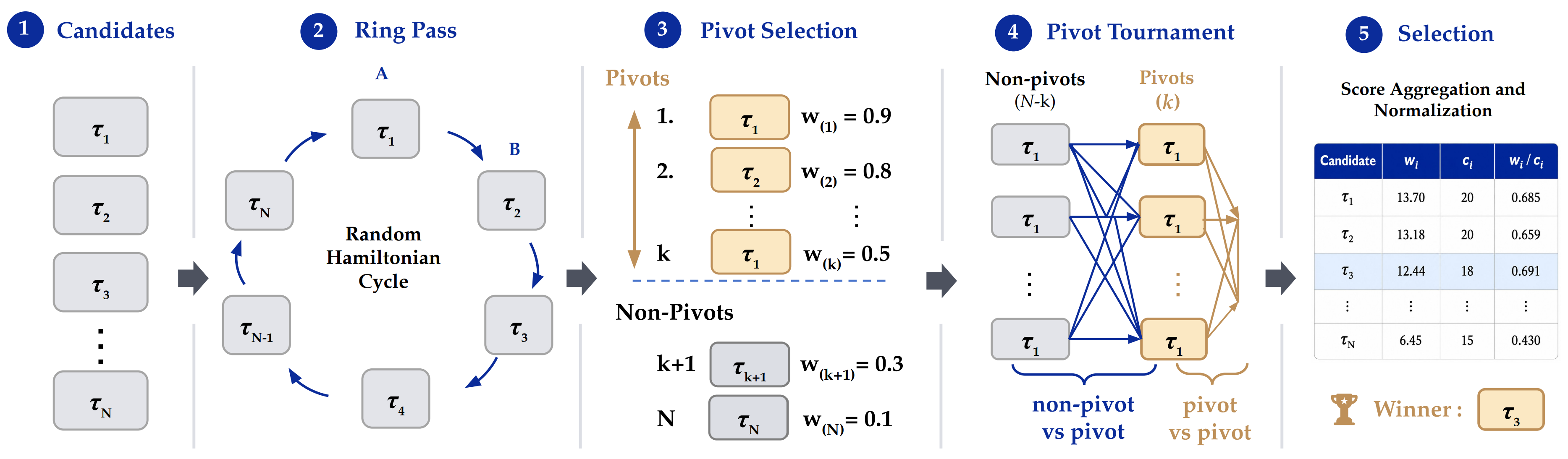
The algorithm#
Candidates: the pool \(\{\tau_1,\dots,\tau_N\}\) to be ranked.
Ring pass: a random Hamiltonian cycle scores the \(N\) adjacent pairs so every candidate appears once in the “A” slot and once in “B”, canceling the model’s positional bias.
Pivot selection: candidates are ranked by their ring-pass scores \(w_{(i)}\), and the top-\(k\) candidates form the pivot set \(\mathcal{P}\).
Pivot tournament: every non-pivot–vs–pivot and pivot–vs–pivot pair is scored via the pairwise preference \(p(a \succ b) = \sigma(R_a - R_b)\), concentrating the budget on uncertain top candidates and cutting cost from \(\mathcal{O}(N^2)\) to \(\mathcal{O}(Nk)\).
Selection: comparisons are aggregated into win mass \(w_i\) and count \(c_i\), and the candidate with the highest normalized \(w_i/c_i\) is returned.
Two-phase scoring#
Scoring is two-phase because the pivots depend on the ring-pass results: select first scores all ring pairs, then chooses pivots, then scores the pivot rounds.
Only the directed pairs the tournament actually needs are scored, and every pair is cached (see the cache argument), so re-runs are incremental.
Tuning#
pivots(k): trades cost for accuracy — more pivots means more comparisons and higher accuracy. Keepksmall relative toN;k ≥ Ndegenerates to a full round-robin (kis clamped toN). The bundled benchmarks default topivots=2.n_evaluations(K): repeats per criterion for each scored pair; the repeated-evaluation scaling axis. Benchmarks default toK=8.seed: seeds the random ring pass. Identical inputs with the same seed run the identical tournament, so results are reproducible.
Cost model#
For one task, the number of directed verifier comparisons is the \(N\) ring pairs plus the pivot-round pairs, each scored \(C \times K\) times (criteria × repeats).
result.n_comparisons reports how many directed comparisons were run:
result = llm_verifier.select(problem, trajectories,
                             criteria="terminal_bench",
                             pivots=2, n_evaluations=8)
print(result.n_comparisons)