
Verification as a Scaling Axis#
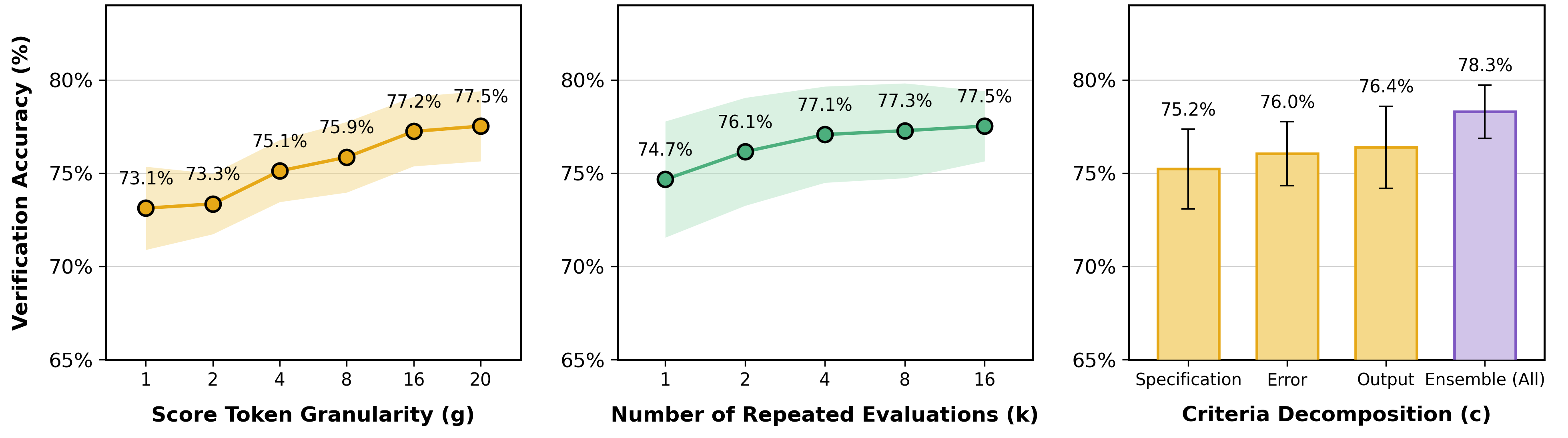
Scaling pre-training, post-training, and test-time compute are the central paradigms for improving LLM capabilities. LLM-as-a-Verifier identifies verification — the ability to determine the correctness of a solution — as a new scaling axis. Verification accuracy consistently improves as we scale across three dimensions: (1) the granularity of score tokens, (2) the number of repeated evaluations, and (3) the decomposition of evaluation criteria.
Score granularity#
Finer score tokens give the decoder a finer space to project the model’s belief, improving separation between correct and incorrect solutions. Accuracy rises from 73.1% (G=1) to 77.5% (G=20) on Terminal-Bench V2.
What drives it: better separation between positive and negative solutions. Decompose the pairwise score gap between correct (\(s_c\)) and incorrect (\(s_i\)) trajectories into a signal and a noise component:
where \(\mathbb{E}[s_c-s_i]\) captures how strongly the verifier prefers the correct trajectory (signal strength) and \(\mathrm{Var}(s_c - s_i)\) captures how inconsistent that preference is across pairs (noise). The signal-to-noise ratio grows with the number of scoring tokens \(G\) (Terminal-Bench V2, \(k{=}16\)):
Granularity \(G\) |
1 |
4 |
16 |
20 |
|---|---|---|---|---|
SNR (k=16) |
0.775 |
0.786 |
0.797 |
0.799 |
Repeated evaluation#
Averaging \(K\) independent evaluations is a Monte Carlo estimator whose variance shrinks as \(O(1/K)\), averaging out per-pass noise. Accuracy rises from 74.7% (K=1) to 77.4% (K=16).
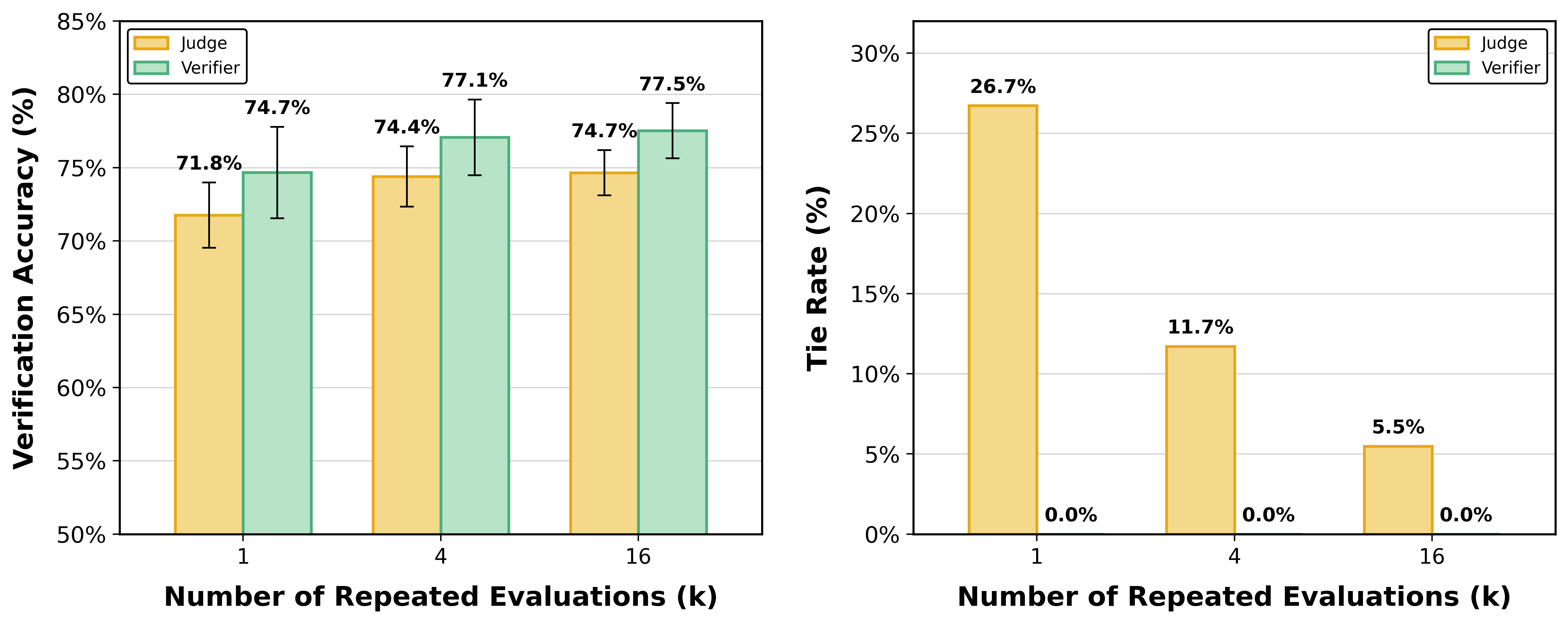
What drives it: variance reduction. LLM-as-a-Verifier consistently outperforms LLM-as-a-Judge, achieving 77.4% verification accuracy while eliminating ties entirely across all repeated verification budgets. Even at \(k = 16\), where repeated verification reduces judge ties, the verifier still maintains 7.2% higher accuracy.
Criteria decomposition#
Granularity and repeated evaluation both assume the rubric itself is adequate. In long-horizon agentic tasks, a judgment like “is this trajectory correct?” conflates several logically distinct factors, and a verifier asked a compound question often latches onto whichever factor is most salient in the prompt.
What drives it: complexity reduction. Replace the single monolithic rubric with an ensemble over \(C\) simpler sub-criteria. For code-agent trajectories, correctness decomposes into three factors that are each easier to verify — Specification (all task requirements satisfied), Output (final output format matches the expected result), and Errors (no failure signals in logs and tool outputs) — with the expected scores averaged across criteria. Any single criterion alone reaches 75.2–76.4% accuracy; their ensemble reaches 78.3%.
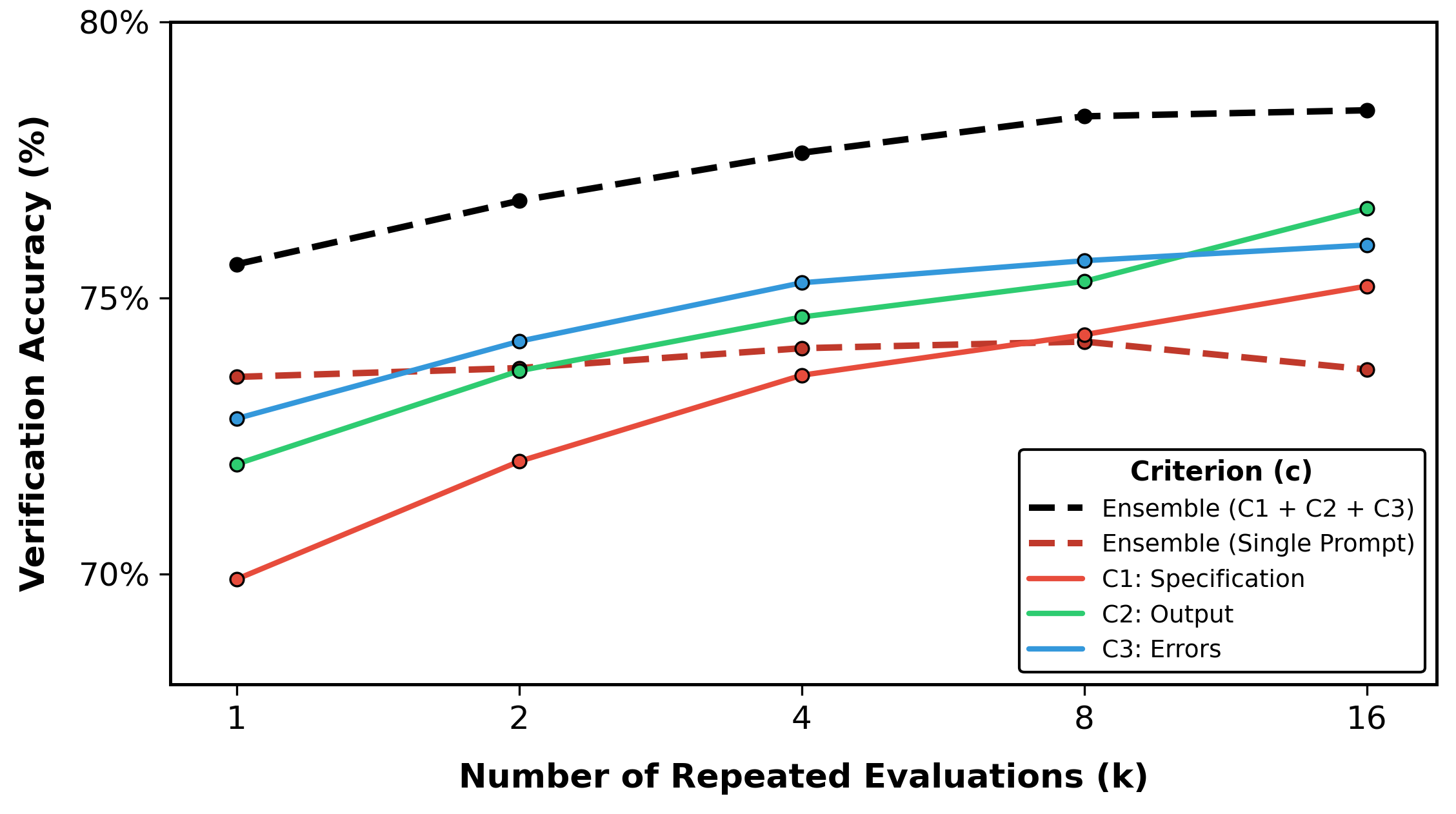
See Writing Verifier Criteria for how to write decomposed criteria for your own task.
Case study: Terminal-Bench query-optimize#
To concretely illustrate how scaling granularity to \(G{=}20\) and the probabilistic formulation sharpen the verifier’s signal, consider a representative trajectory pair from the query-optimize task on Terminal-Bench V2.
The agent is given a slow SQL query and asked to produce an equivalent optimized version; both candidates run faster, but only one validates equivalence against the canonical database.
Over 100 repeated evaluations, a discrete 1–5 judge collapses these nuanced assessments into ties (88/100). Taking the expectation over the same 5-point distribution eliminates ties entirely and ranks the correct trajectory higher in 69/100 runs; scaling granularity to \(G{=}20\) sharpens the signal further, ranking it strictly higher in 77/100 runs.
Method |
correct > incorrect ✅ |
correct = incorrect ⚖️ |
correct < incorrect ❌ |
|---|---|---|---|
Judge (discrete, G=5) |
12/100 |
88/100 |
0/100 |
Verifier (continuous, G=5) |
69/100 |
0/100 |
31/100 |
Verifier (continuous, G=20) |
77/100 |
0/100 |
23/100 |